
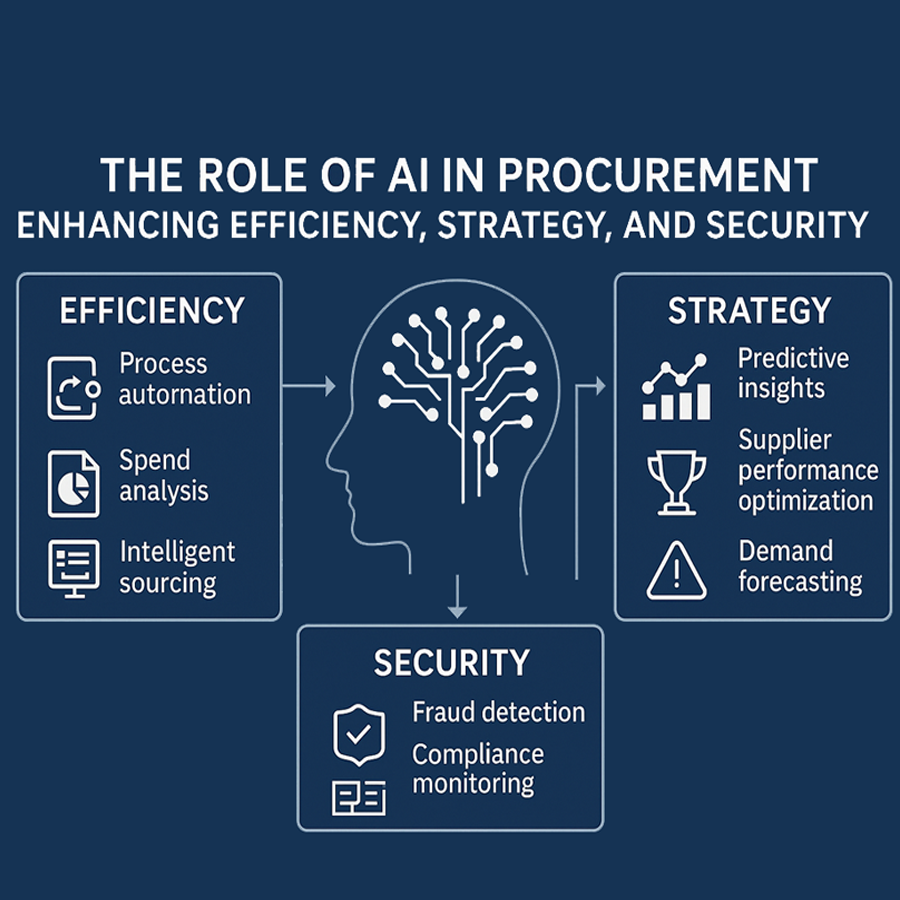
The Role of AI in Procurement: Enhancing Efficiency, Strategy, and Security
By GagnaPro Solutions – Procurement Thought Leadership Series
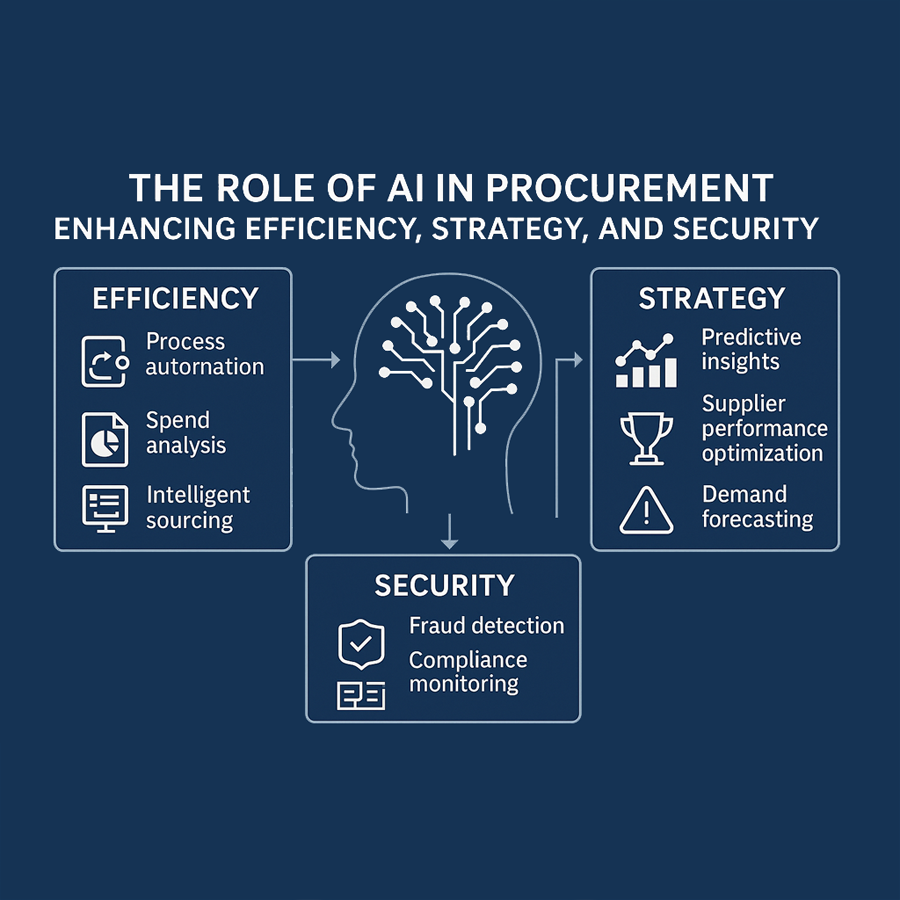
Introduction: Procurement’s New Mandate in a Shifting Business Landscape
In today’s hyper-competitive and volatile global marketplace, procurement is no longer just a cost center—it is a strategic function at the nexus of value creation, risk mitigation, and innovation. But with rising economic uncertainty, supply chain disruptions, ESG demands, and growing regulatory scrutiny, procurement leaders face intensifying pressure to deliver more value with fewer resources. The traditional toolkit—centered around manual processes, fragmented data, and legacy systems—is proving insufficient for this mandate.
Enter Artificial Intelligence (AI). From predictive analytics to autonomous sourcing, AI is redefining how procurement functions operate, make decisions, and safeguard enterprise value. McKinsey estimates that AI could generate up to $1.1 trillion annually in procurement and supply chain functions globally, primarily through improved efficiency, forecasting, and risk management. As AI capabilities mature—from machine learning (ML) to generative AI and large language models (LLMs)—the opportunity for procurement organizations to lead strategic transformation has never been more compelling.
This article explores how AI is reshaping procurement along three critical dimensions: efficiency, strategy, and security. It also offers a roadmap for C-suite executives seeking to embed AI capabilities into their procurement DNA for long-term resilience and competitive advantage.
1. Efficiency: Automating the Engine of Procurement Operations
Process Automation & Cognitive Procurement
At the heart of AI’s impact lies its ability to automate time-consuming, repetitive tasks with speed and accuracy. Intelligent bots powered by Robotic Process Automation (RPA) and AI can manage routine procurement activities such as PO creation, invoice matching, contract renewal alerts, and vendor onboarding—freeing up valuable human bandwidth for strategic roles. Deloitte reports that organizations using AI-driven procurement automation have seen up to a 65% reduction in procurement cycle time and a 35% improvement in sourcing productivity.
Spend Analysis & Tail Spend Optimization
AI tools analyze vast and unstructured spend data from ERP, P2P, and sourcing systems to uncover savings opportunities, maverick spend, and leakage points. Natural Language Processing (NLP) helps categorize spend across thousands of suppliers and GL codes in real time. Companies such as Unilever and Siemens have leveraged AI-based spend analytics to reduce indirect spend by 8–12% annually.
Intelligent Sourcing & eAuction Design
AI platforms like LevaData and Keelvar enable strategic sourcing by recommending optimal supplier mixes, simulating cost scenarios, and designing data-driven eAuctions. These tools adapt based on past sourcing outcomes, market indices, and supplier performance, thus improving sourcing speed and negotiation outcomes. For instance, a global automotive manufacturer reported $120M in savings over three years using AI-powered sourcing bots.
2. Strategy: Empowering Smarter Procurement Decisions
Predictive Insights & Demand Forecasting
AI-driven platforms can integrate historical spend, demand data, external market trends, and supplier behavior to generate predictive forecasts. These insights allow procurement teams to anticipate raw material cost escalations, supplier disruptions, and category-level risks. According to BCG, predictive procurement analytics has helped firms improve forecast accuracy by 30% and reduce inventory holding costs by 20–25%.
Supplier Performance Optimization
AI augments Supplier Relationship Management (SRM) by continuously assessing supplier KPIs—delivery timelines, quality metrics, price competitiveness, and ESG compliance—against benchmarks and SLAs. Machine learning models can identify patterns and flag suppliers at risk of underperformance. Some companies now deploy AI-driven SRM dashboards that generate dynamic supplier scorecards, enabling real-time supplier collaboration and escalation protocols.
Category Strategy Development
Generative AI is emerging as a powerful tool for strategic category management. It can synthesize competitive intelligence, market pricing trends, contract terms, and supplier innovations to co-develop sourcing playbooks. Platforms like ChatGPT Enterprise and Microsoft Copilot are being integrated with procurement systems to create RFP drafts, contract summaries, and negotiation scripts—cutting down weeks of manual effort.
3. Security: Reinforcing Governance and Risk Management
Fraud Detection & Anomaly Tracking
Procurement fraud costs global businesses over $2.9 trillion annually, according to the Association of Certified Fraud Examiners. AI can proactively flag suspicious activity—duplicate invoices, off-contract purchases, supplier collusion—by identifying anomalies in transaction data. For example, advanced ML models detect fraud patterns across multi-year procurement data with over 90% accuracy, significantly reducing audit lag.
Compliance Monitoring & Policy Adherence
AI helps enforce procurement policies by integrating internal guidelines with real-time transaction validation. Contracts can be cross-checked against local regulatory thresholds or ESG norms, reducing non-compliance risk. Some AI tools provide automated alerts when procurement teams bypass preferred suppliers or exceed delegated authority—enabling continuous policy reinforcement.
Supply Chain Risk Intelligence
AI platforms now scrape thousands of external data sources—news feeds, regulatory databases, financial filings, social media—to assess third-party risk in real time. From geopolitical tensions to financial insolvency to ESG violations, these tools generate actionable risk heatmaps for procurement leaders. Companies like IBM and DHL deploy AI-based supply chain risk engines to enhance visibility and reduce response times by 50% during disruptions.
Technology Trends to Watch
- Generative AI in Procurement Co-pilots: Tools like SAP Joule and Oracle AI Assistants are embedding LLMs into procurement workflows to support contract analysis, negotiation simulations, and intelligent Q&A for buyers.
- Autonomous Procurement Agents: AI agents can now autonomously execute low-risk purchases, monitor thresholds, and trigger reorders—enabling true touchless procurement.
- AI-Driven ESG Analytics: Tools like EcoVadis and Resilinc are leveraging AI to assess supplier sustainability scores and track Scope 3 emissions.
- Integrated AI Suites: End-to-end procurement platforms (e.g., Coupa, Ivalua, GEP SMART) are embedding AI modules for sourcing, contracting, and supplier risk in one ecosystem.
Executive Recommendations: Embedding AI into Procurement DNA
To fully unlock AI’s potential in procurement, C-suite executives must act on three strategic fronts:
- Invest in Data Foundations: AI is only as powerful as the data that fuels it. Organizations must harmonize procurement data across systems, clean master supplier data, and implement robust taxonomy governance.
- Adopt an AI-First Operating Model: Procurement should transition from transactional teams to AI-augmented roles—data translators, supplier intelligence analysts, and category innovation managers. Empowering teams with user-friendly AI tools fosters adoption and innovation.
- Pilot, Scale, and Govern: Start with high-ROI use cases—like spend analytics or invoice matching—and gradually scale to strategic areas. Establish an AI governance board to monitor model bias, data security, and regulatory compliance.
- Integrate with the Broader Digital Strategy: AI in procurement must align with enterprise-wide digital transformation and ESG agendas. Procurement leaders should co-own digital roadmaps with IT and sustainability teams.
Conclusion: A New Procurement Paradigm Powered by AI
As economic pressures mount and supply chain volatility becomes the norm, procurement must evolve from reactive cost management to proactive value creation. AI offers not just automation, but transformation—turning procurement into a predictive, resilient, and intelligent function. By embracing AI across efficiency, strategy, and security dimensions, C-suite leaders can elevate procurement from the back office to the boardroom.
In the race for competitive advantage, those who embed AI into procurement today will shape the value chains of tomorrow.