
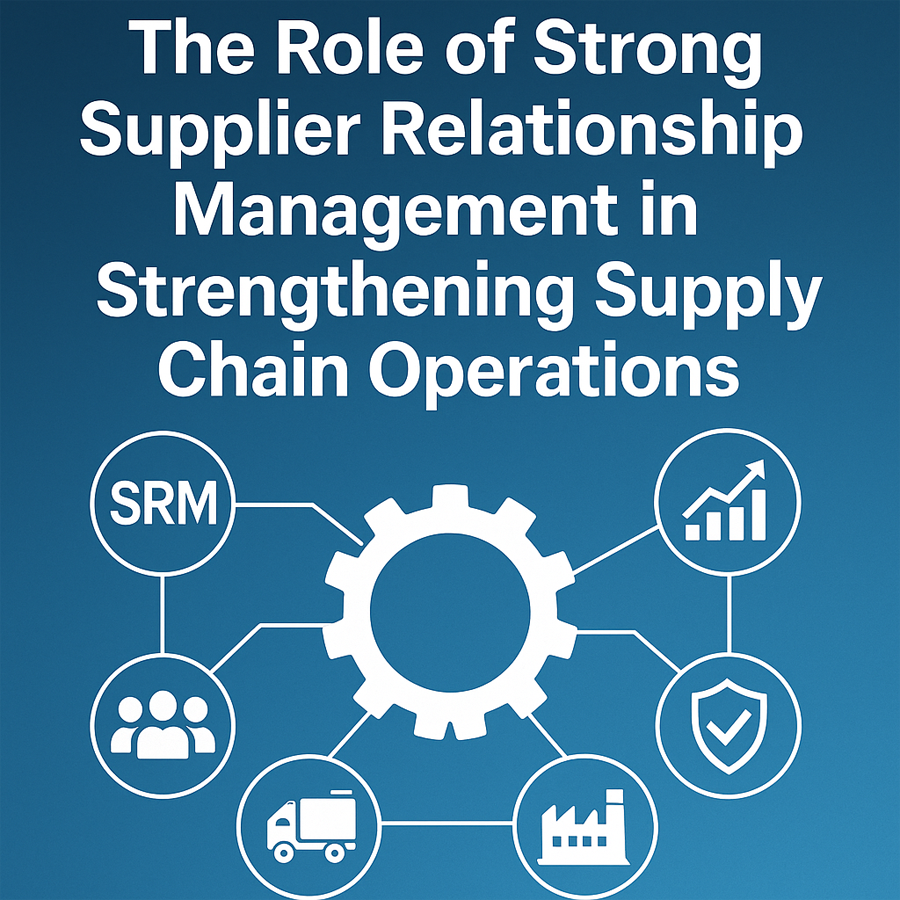
The Role of Strong Supplier Relationship Management in Strengthening Supply Chain Operations
By GagnaPro Solutions – Procurement Thought Leadership Series
Introduction: Navigating Complexity in a Shifting Global Supply Chain Landscape
Today’s global supply chains operate in an era defined by volatility, uncertainty, complexity, and ambiguity (VUCA). The once-linear supply chain has evolved into a dynamic, interconnected ecosystem vulnerable to geopolitical tensions, pandemics, climate-related disruptions, regulatory pressures, and demand fluctuations. In this environment, traditional procurement models focused solely on cost reduction or transactional efficiency fall short. Instead, Supplier Relationship Management (SRM) has emerged as a strategic capability—no longer a “nice-to-have,” but a “must-have” for competitive, resilient, and responsive operations.
According to a 2023 McKinsey Global Institute report, disruptions lasting a month or longer now occur every 3.7 years, with the potential to erase up to 45% of one year’s EBITDA over a decade in certain industries. The differentiator? Organizations that invested in deeper, collaborative supplier relationships rebounded faster and performed stronger post-disruption.
This article explores how robust SRM enhances operational performance and builds strategic advantage across industries—and why C-suite executives must embed SRM at the core of their procurement and supply chain strategy.
How Strong SRM Strengthens Supply Chain Operations
1. Enhancing Resilience and Business Continuity
At its core, SRM involves proactive management of a company’s interactions with the organizations that supply goods, services, and capabilities. When implemented as a strategic function, SRM enables companies to:
- Identify and develop critical suppliers
- Foster collaborative planning and joint problem-solving
- Create shared risk management frameworks
- Maintain visibility into upstream risks beyond Tier 1 suppliers
A Deloitte survey (2022) found that 74% of organizations with formal SRM programs were better equipped to respond to COVID-19 disruptions, particularly in ensuring continuity of critical supplies.
Case in point: Toyota, known for its long-term supplier partnerships, was able to recover faster post-earthquake in Japan due to its advanced SRM practices, which included tiered supplier mapping, shared recovery planning, and frequent communication protocols.
2. Driving Agility and Responsiveness
In volatile markets, responsiveness is a competitive advantage. Companies with strong supplier relationships can pivot faster to shifts in demand, regulatory changes, or raw material constraints. Agile SRM strategies prioritize:
- Transparent and real-time information sharing
- Joint forecasting and demand planning
- Rapid escalation and resolution protocols
- Multi-sourcing and nearshoring decisions made collaboratively
Frameworks such as the Kraljic Matrix and Supplier Segmentation Models (strategic, preferred, transactional) help procurement leaders determine the depth of engagement required for each supplier category, enabling agility without bloating costs.
3. Unlocking Innovation and Co-Development
World-class companies treat suppliers not just as vendors but as partners in innovation. Strong SRM fosters early engagement in product design, value engineering, and sustainability solutions.
For example, Procter & Gamble’s Connect + Develop program formalized co-innovation with suppliers and startups. Over 50% of its innovations now originate from external collaborations. These partnerships reduce R&D costs, accelerate time-to-market, and often yield environmentally sustainable solutions—critical to ESG commitments.
Key practices include:
- Joint business reviews and innovation days
- Collaborative KPIs tied to innovation metrics
- Open IP frameworks and shared investment models
4. Improving Cost Efficiency and Value Creation
While SRM goes beyond cost, it is also a powerful lever for savings through:
- Total Cost of Ownership (TCO) analysis instead of just purchase price
- Should-cost modeling and clean-sheet costing
- Joint process improvement (Lean Six Sigma or Kaizen projects)
- Volume consolidation across business units for better leverage
A Capgemini study revealed that companies with mature SRM capabilities achieved 2.5x greater cost savings on average, compared to those with ad-hoc supplier management. SRM also helps identify and eliminate hidden costs stemming from quality issues, delays, or compliance failures.
5. Strengthening Compliance and Risk Mitigation
In today’s ESG-driven regulatory climate, compliance is as critical as cost or quality. SRM supports risk management by:
- Establishing clear governance frameworks
- Integrating supplier audits and performance reviews
- Ensuring contract compliance and adherence to ethical standards
- Monitoring ESG metrics, conflict minerals, and anti-bribery clauses
Technologies such as third-party risk platforms, blockchain traceability, and AI-driven alert systems now integrate seamlessly with SRM tools to flag early warnings. Companies like Unilever use blockchain to trace palm oil back to its origin, reducing reputational risks and ensuring supply chain integrity.
6. Leveraging Technology for Scalable SRM
Digitalization is the cornerstone of modern SRM. Leading platforms—SAP Ariba, Coupa, Ivalua, and Jaggaer—offer integrated solutions for:
- Supplier onboarding and qualification
- Performance and risk scoring dashboards
- Predictive analytics for disruption forecasting
- Digital collaboration portals for shared KPIs and workflows
Artificial Intelligence (AI) and Machine Learning (ML) now enhance SRM by offering supplier sentiment analysis, spend pattern recognition, and early warning signals. Natural Language Processing (NLP) is being used to extract risk signals from news, social media, and supplier communication.
Digital maturity in SRM also enables supplier diversity tracking, CO2 emission monitoring, and real-time compliance status—directly supporting ESG and DEI objectives.
Conclusion: SRM as a Strategic Differentiator
As global supply chains evolve from transactional efficiency toward strategic orchestration, the importance of SRM will only intensify. It is no longer sufficient to negotiate favorable contracts and hope for supplier performance. Proactive, data-driven, and collaborative SRM must be institutionalized across the organization.
Executive Recommendations: Embedding SRM into Core Strategy
- Segment Suppliers Strategically: Use the Kraljic Matrix to classify suppliers by risk and value, enabling differentiated engagement models.
- Establish Governance: Form SRM steering committees with cross-functional representation—procurement, quality, risk, legal, sustainability.
- Invest in Technology: Prioritize SRM platforms with analytics, integration capabilities, and ESG traceability.
- Define Shared KPIs: Move beyond internal metrics. Co-create KPIs with suppliers tied to delivery, innovation, compliance, and resilience.
- Foster Collaboration: Conduct joint business planning, innovation workshops, and supplier capability-building initiatives.
- Measure Maturity: Use SRM maturity models to benchmark progress and identify gaps. Mature organizations should evolve toward supplier ecosystems.
Long-Term Organizational Benefits
- 20–30% faster time to recovery from disruptions
- 10–15% reduction in procurement operating costs
- Higher supplier satisfaction and innovation contribution
- Improved ESG scores and reduced reputational risk
- Elevated customer experience through supply continuity and quality
As volatility becomes the new normal, strong SRM will be the foundation upon which agile, sustainable, and future-ready supply chains are built. For C-suite leaders, the message is clear: investing in Supplier Relationship Management today secures supply chain competitiveness tomorrow.